
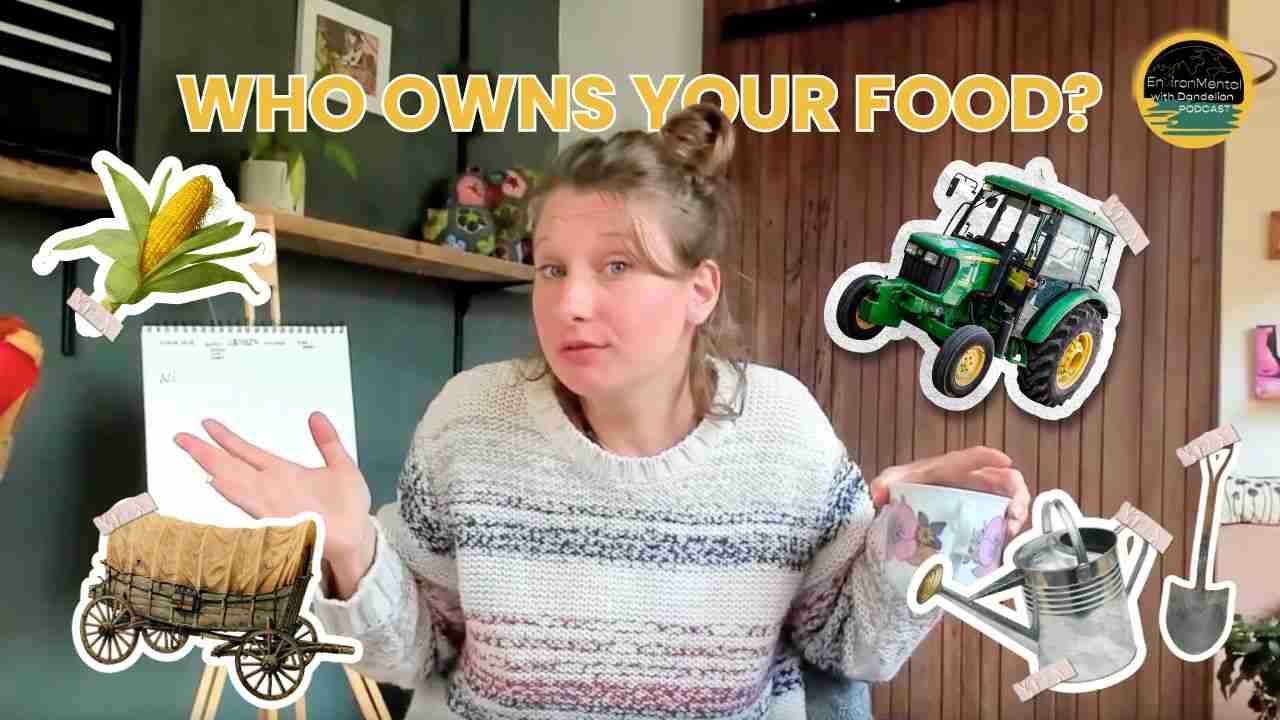
Being a plant lady in 2026 isn’t just about dirty feet and watering cans—it’s about wanting to know where our food comes from. For thousands of years, humans shared food through local connection and community trade. Today, grocery store shelves are dominated by chemical-coated products tied to consolidated corporate supply chains we can’t see or control.
In Part 6 of The Extractive Tapestry series on the EnvironMental Podcast, we uncover the corporate monopolies, government subsidies, and lobbying efforts behind industrial agribusiness.
Click Here to Watch this Full Episode on Youtube
The Full Extractive Tapestry Series
- Extractive Tapestry Part 1: Administrative Gatekeepers
- Extractive Tapestry Part 2: The Technocrats
- Extractive Tapestry Part 3: Military Industrial Complex
- Extractive Tapestry Part 4: The Judicial System
- Extractive Tapestry Part 5: Influencers & Overconsumption
- Extractive Tapestry Part 6: The Agricultural Monopolies (You Are Here)
- Extractive Tapestry Part 7: Religion
What Agribusiness looks like today…
“Today’s food growing agribusiness is all about concentrating businesses so that today, there are a handful of organizations that control the world’s crop seeds, fertilizers, pesticides, and machinery.” – Clapp.
The point is so much less about safe food, and more about how to protect the big profits that come to those select few businesses.
“Economists find that market abuses—such as price fixing, price gouging, and wage fixing—are likely to occur when the concentration ratio of the top four firms (CR4) exceeds 40%.” – Farm Action
In global agriculture, the CR4 far exceeds the 40% threshold across almost every category. Here are a few examples:
- Global Seed: 51.0% (Bayer, Corteva, ChemChina, BASF)
- Agrichemicals: 62.3% (Bayer, Corteva, ChemChina, BASF)
- Nitrogen Fertilizer: 84.0% (Nutrien, CF Industries, Koch, Yara)
- Phosphate Fertilizer: 86.0% (Mosaic, Nutrien, OCP, Ma’aden)
- Potash Fertilizer: 89.0% (Nutrien, Mosaic, Belaruskali, Uralkali)
To Read
- https://landclimate.org/how-a-few-giant-companies-came-to-dominate-global-food/
- https://mitpress.mit.edu/9780262551700/titans-of-industrial-agriculture/
- https://farmaction.us/agriculture-consolidation-data-hub/
Greenwashing in Big Ag
Mainstream sustainability lists often highlight chemical conglomerates under the banner of “eco-friendly agriculture” like this Sustainability Mag Top 10 List.
It’s super ultra greenwashing. I don’t know if there’s a scale. But this one is up there with Shein.
- Bayer (Monsanto): Dominates seeds and pesticides while setting aside billions to pay out ongoing glyphosate cancer lawsuits.
- Nutrien: A massive fertilizer merger controlling global potash and chemical distribution.
- Syngenta: Owned by ChemChina, leading the charge on synthetic chemicals and patented seeds.
- Corteva Agriscience: A spinoff of DowDuPont—bringing a long legacy of industrial chemical manufacturing and toxic pollution.
This episode goes into the DowDuPont of it all, which if you don’t know they covered up dioxin poisoning in the Michigan Tittabawasee River together with Ronald Regan in the 80s along with several other scandals.
To Read:
- Bayer: https://www.bayer.com/en/about-us
- Nutrien: https://www.nutrien.com/about
- Syngenta: https://www.syngenta.com/company/our-history
- Corteva: https://www.corteva.com/who-we-are/our-history.html
- The Dow Stuff:
- April’s Post: https://dandelionbranding.com/ep-food-security/
Big Ag & the Government (The “Feed-Meat” Complex)
According to the United States Department of Agriculture, the top five products in the U.S. are corn, cattle, soybeans, dairy products, and broilers (chickens raised for food).
And is is any wonder why? The government subsidises corn and soy (livestock feed) to the tune of billions. Here’s how it works:
The government subsidizes the growth of corn and soy. In 2024 alone, corn and soy accounted for nearly half of all federal farm subsidies in the US. They are the only crops to pass $1 Billion in payouts.
Subsidies help to guarantee insurance and other financing to farmers, pricing out the unsubsidized fruit and veg farmers.
Farmers transition to the guaranteed income of corn and soy crops, flooding the market with cheap produce and driving down the cost of livestock feed in the country.
Reducing the cost of livestock feed lowers meat prices, and drives up the prices in the unsubsidized local vegetable market.
Then simply, people eat more meat because it’s cheaper.
That extra cash influx goes strategically to politicians and agricultural lobbies, who work to keep the status quo.
Like this example with the EU Green Deal: Copa-Cogeca regularly overturn environmental protections, including landmark EU pesticide reduction targets from The Guardian.
To Read
- https://farmaction.us/2020/11/16/thefeedmeatcomplex/
- https://www.investopedia.com/terms/a/agribusiness.asp
- https://usafacts.org/articles/federal-farm-subsidies-what-data-says/
- https://www.theguardian.com/world/2026/jul/16/how-europe-most-powerful-farming-lobby-copa-cogeca-killed-eu-pesticide-law
History in 30 Seconds: How did Farming Become an Industry?
21,000 BC – 1940s: Farming was driven by community stewardship, rotational cropping, and seed saving.
Post-WWII: WWII chemical manufacturers converted wartime nitrogen production into synthetic fertilizers.
1955: Economist John Davis coined the term “Agribusiness,” officially redefining farming from a human necessity to a component of an industrial supply chain (Research Paper).
This shift happened FAST. But there are tons of solutions on the horizon. Everything from AI to vertical gardening AND the transition to regenerative agriculture is really happening.
To read:
- https://www.nationalgeographic.com/culture/article/neolithic-agricultural-revolution
- https://en.wikipedia.org/wiki/History_of_agriculture
- https://seeds.ca/schoolfoodgardens/history-of-agriculture-to-the-second-world-war/
- https://www.choicesmagazine.org/choices-magazine/submitted-articles/the-history-consolidation-and-future-of-the-us-nitrogen-fertilizer-production-industry
- https://www.researchgate.net/publication/398385119_A_Review_on_the_Evolution_of_Agribusiness_in_the_21st_Century
- https://www.soilheroesfoundation.com/farmer-guidebook-2-0/
- https://www.linkedin.com/pulse/food-systems-2026-shifts-reshaping-how-we-produce-move-charles-oron-63uzf/
- https://kadence.com/en-us/knowledge/top-4-trends-set-to-disrupt-the-agriculture-industry-in-2025/
5 Practical Steps to Reclaim Your Food System
- Support Local CSAs: Buy directly from smallholder farms to give local growers predictable income.
- Shift Toward Local, Plant-Based Foods: Reduce reliance on subsidized industrial meat and monocropped produce.
- Grow & Save One Seed: Grow a staple herb or vegetable at home and save its seeds to bypass commercial seed monopolies.
- Demand Better Grocery Stock: Request that local grocery managers stock products from short, ethical supply chains.
- Become a Citizen Lobbyist: Sit in on local decision-making meetings and use resources like The Good Lobby to advocate for sustainable food policies.
About Dandelion Branding
Dandelion Branding is a nature-based strategy studio helping values-driven businesses build honest storytelling and zero-greenwash communications engines. Subscribe to the EnvironMental Podcast on YouTube for more episodes.